Government launches electric buses in Kampala, signaling shifts to cleaner urban transport
By our Reporter
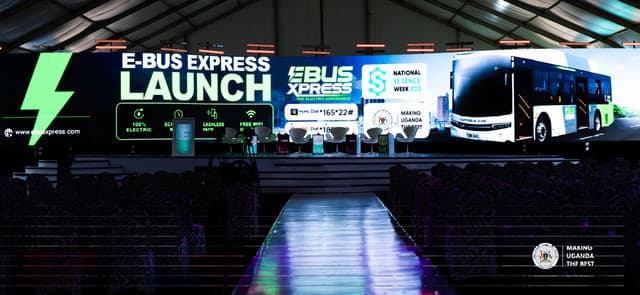
KAMPALA — A new chapter in Uganda’s urban mobility journey has begun with the official rollout of the E-Bus Xpress (EBX), a government-backed electric public transport system now operating across key routes in the Greater Kampala Metropolitan Area (GKMA).
The launch, held during the National Science Week 2026, introduces locally manufactured Kayoola electric buses developed by Kiira Motors Corporation, marking a significant step toward modernizing the capital’s long-troubled transport network.
Each bus has a capacity of 90 passengers and a range of up to 300 kilometers on a single charge.
For years, Kampala has grappled with worsening traffic congestion, an aging fleet of diesel-powered taxis, and thousands of unregulated boda-bodas. The result has been chronic gridlock, with studies estimating that traffic congestion costs Uganda more than $800 million annually in lost productivity, wasted fuel, and commuter delays of up to 90 minutes daily.

The E-Bus Xpress aims to
address these challenges by introducing a cleaner, more organized, and efficient public transport alternative. The inaugural routes include City Square–Nakawa–Ntinda–Bukoto, Kamwokya–Wandegeya, and connecting corridors between Ntinda and the city centre—areas known for heavy congestion and high commuter demand.
At the launch, State Minister for Science and Technology, Ms Monica Musenero, said the buses will initially operate on selected routes as government studies commuter patterns and market response.
"All Ugandans, you know now that globally, there is a challenge of fuel, so to alleviate this crisis, we had to introduce these electric buses," she said.
Minister for Works and Transport, Gen Katumba Wamala, outlined the government’s long-term vision to expand the e-mobility program nationwide.
"As already said, by June 2030, the plan is to roll out this service across the nation, making all 14 cities with about 1500 buses," Gen Katumba said.
The Kampala pilot phase has commenced with eight buses, with further deployment expected to be guided by demand and operational performance.
Beyond easing congestion, the introduction of electric buses is also expected to deliver environmental benefits. Kampala’s air quality has steadily deteriorated due to vehicle emissions, with transport contributing a significant share of urban air pollution.
Electric buses produce zero tailpipe emissions, reduce noise pollution, and lower dependence on fossil fuels, positioning e-mobility as a critical solution in tackling climate change and improving public health in rapidly growing cities.
The EBX system is also integrating digital innovation into public transport.
Through partnerships involving telecom players such as MTN Uganda, commuters will access onboard Wi-Fi, cashless payments via mobile money, and real-time bus tracking powered by Internet of Things (IoT) technologies. These features are expected to enhance convenience, improve reliability, and streamline operations.
Officials say the broader goal is to shift commuters away from informal, overcrowded, and polluting transport modes toward a structured system that is safer, more predictable, and efficient.
However, experts caution that the success of the initiative will depend on complementary investments, including dedicated bus lanes, strict enforcement of traffic regulations, and integration with existing urban infrastructure.
Uganda’s push into electric mobility has already attracted international attention.
Last year, Kiira Motors Corporation secured a $150 million deal to supply 450 electric buses to a South African firm, following a successful 13,000-kilometre demonstration journey from Kampala to Cape Town.
Government officials say such developments highlight the potential of Uganda’s home-grown automotive industry not only to transform domestic transport but also to create jobs and drive industrial growth.
"So apart from even making our travel easy, the employment opportunities, all these are going to be run by human beings. This transition is an engine for wealth. We will create jobs and job opportunities at every level," Gen Katumba explained.
While challenges remain, the arrival of electric buses on Kampala’s streets signals a decisive shift toward a future defined by cleaner energy, smarter mobility, and locally driven innovation.