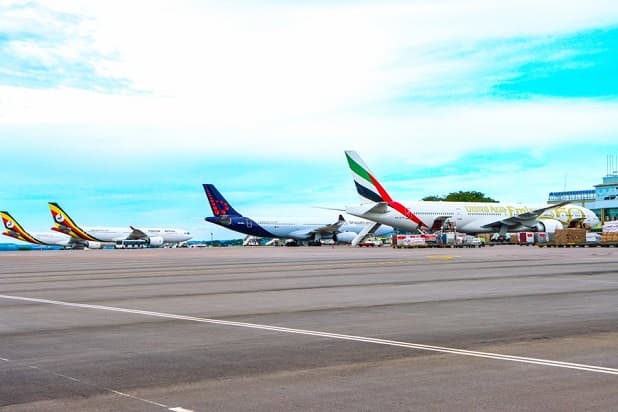
Uganda’s aviation sector suffered a major setback in the first quarter of 2026 following airspace disruptions in the Middle East that triggered flight suspensions, sharp cargo declines, rising travel costs, and reduced passenger traffic through Entebbe International Airport.
The Uganda Civil Aviation Authority (UCAA) says the crisis, which began after the temporary closure of airspace in parts of the Middle East on February 28, disrupted one of Uganda’s most critical aviation corridors and exposed the country’s heavy dependence on Gulf aviation hubs such as Dubai, Doha, and Sharjah for passenger transit and cargo exports.
Speaking during a media briefing at the Uganda Media Centre on Friday, UCAA Director General Fred Bamwesigye described the situation as a significant blow to the sector.
“Global aviation was significantly disrupted following the temporary closure of airspace in parts of the Middle East beginning February 28, 2026. Uganda was not spared,” Bamwesigye said.
He revealed that several airlines operating Middle East routes from Entebbe, including Emirates, Fly Dubai, Air Arabia, Qatar Airways and Uganda Airlines, temporarily suspended flights before gradually resuming operations in phases.
“These airlines continue to closely monitor the situation and adjust their schedules accordingly. The disruptions had a considerable impact on passenger and cargo traffic through Entebbe, contributing to increased ticket costs and reduced revenues across the sector,” he added.
According to UCAA figures, international passenger arrivals at Entebbe International Airport dropped by 7.9 percent between January and March 2026, falling from 260,434 passengers in the same period last year to 239,850 passengers.
International departures also declined by 8.5 percent, dropping from 290,594 passengers in the first quarter of 2025 to 265,941 passengers this year.
The impact was even more severe on cargo exports, which remain vital to Uganda’s economy, particularly for fresh agricultural products destined for Europe, Asia, and the Middle East through Gulf transit hubs.
Cargo exports declined by 28.9 percent during the quarter, falling from 10,534 metric tonnes in 2025 to 7,490 metric tonnes in 2026. Imports also reduced by 9 percent, from 4,932 to 4,490 metric tonnes.
The worst effects were recorded in March 2026 when cargo exports plunged by 45.2 percent compared to the same month last year, dropping from 3,886 to 2,130 metric tonnes.
Imports in March also fell sharply by 30.3 percent, from 1,965 to 1,369 metric tonnes.
The disruptions particularly affected Uganda’s time-sensitive exports such as fresh flowers, fish, fruits, and vegetables that depend heavily on reliable Middle Eastern connections for global distribution.
Industry analysts say rerouting flights around restricted airspace significantly increased operational costs for airlines due to higher fuel consumption, costs that were ultimately passed on to travelers through more expensive air tickets.
The disruptions also affected thousands of Ugandan migrant workers seeking employment opportunities in the Gulf region, especially in construction and domestic work sectors, after flights to the United Arab Emirates, Qatar, and Saudi Arabia were cancelled or delayed.
Tourism was equally affected as international travelers faced longer travel routes, flight cancellations, and increased travel costs, leading to reduced safari bookings despite Uganda’s tourism sites remaining fully operational.
Despite the downturn in passenger and cargo traffic, Uganda’s airspace remained relatively active.
Aircraft movements increased by 7.7 percent, rising from 7,817 to 8,420 movements, while overflights grew by 2.6 percent from 6,258 to 6,423.
Bamwesigye said this demonstrated continued confidence and strategic interest in Uganda’s airspace despite the regional instability.
“An indication of continued interest in Uganda’s airspace,” he noted.
UCAA data, however, showed signs of gradual recovery in April 2026.
The airport recorded 94,320 arriving passengers and 94,810 departing passengers, translating into a total of 189,130 international passengers and an average of 6,304 passengers per day.
This represented an increase of 4,930 passengers compared to April 2025.
Cargo traffic, however, remained under pressure.
Exports and imports combined totaled 4,823 metric tonnes in April 2026 compared to 6,098 metric tonnes recorded during the same period last year, representing a deficit of 1,275 metric tonnes.