

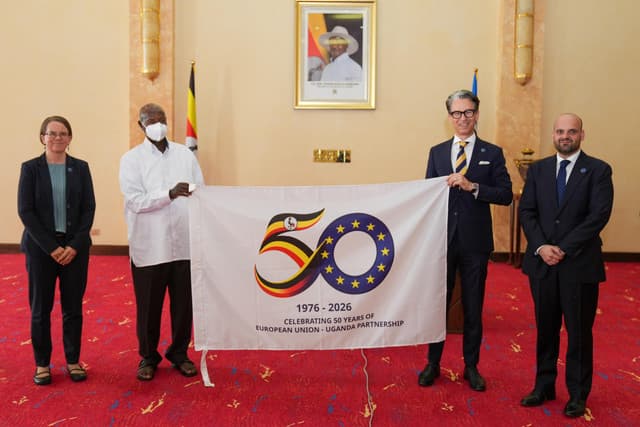
President Museveni Pushes EU to Back Africa’s Industrialization Agenda
President Yoweri Kaguta Museveni has called on Europe and other international partners to shift support toward Africa’s industrialization and value-addition agenda, arguing that the continent cannot attain sustainable prosperity while remaining an exporter of raw materials and an importer of finished goods.
The President made the remarks on Tuesday during a meeting at State House Entebbe with Jan Sadek and his delegation as Uganda and the European Union reflected on 50 years of diplomatic and development cooperation
“A richer and more prosperous Africa is good for business, investment and trade for both our continents,” Museveni said, urging European partners to work with African countries in unlocking economic potential through industrialization, infrastructure development and value addition.
The meeting came amid a series of high-level engagements between Museveni and European diplomats, underlining the deepening strategic relationship between Uganda and the European bloc.
Earlier, Museveni held discussions with Frederieke Quispel on continued agricultural cooperation, including ongoing study tours exposing Ugandan farmers to modern technologies and innovative farming practices in the Netherlands.
Museveni also met outgoing German Ambassador Matthias Schauer and thanked him for his contribution toward strengthening bilateral relations between Uganda and Germany during his tenure.
Together, the engagements reflect Europe’s expanding footprint in Uganda’s agriculture, energy, infrastructure, and governance sectors through both bilateral partnerships and broader EU-backed initiatives.
The European Union remains one of Uganda’s largest development and trade partners, channeling investments through initiatives such as the Global Gateway strategy. EU-supported programmes in Uganda span renewable energy expansion, agribusiness financing, digital connectivity, transport infrastructure and refugee support.
Among the flagship interventions is the €170 million rehabilitation of the Nalubaale and Kiira hydropower dams in Jinja, financed through a combination of EU grants and concessional loans from the European Investment Bank and the French Development Agency. The project is expected to stabilize Uganda’s electricity supply, sustain the dams’ combined 380 megawatts generation capacity and extend their operational lifespan by another 30 years while improving climate resilience on the River Nile.
The EU has also invested heavily in solar mini-grids, rural electrification, forestry restoration and telecommunications infrastructure aimed at expanding 4G and 5G connectivity in underserved regions.
Through initiatives such as Sustainable Business for Uganda (SB4U), the bloc is additionally supporting private sector growth, green jobs and Uganda’s trade competitiveness.
Museveni’s latest appeal signals Uganda’s intention to reposition its relationship with Europe beyond traditional aid and humanitarian assistance toward investment-driven industrial growth.
The President has repeatedly argued that Africa’s long-term prosperity depends on processing its own raw materials, building industries and expanding infrastructure capable of supporting modern economies.
His remarks to EU diplomats reinforce Kampala’s push for partnerships that prioritize technology transfer, industrial investment and production capacity rather than dependence on commodity exports.