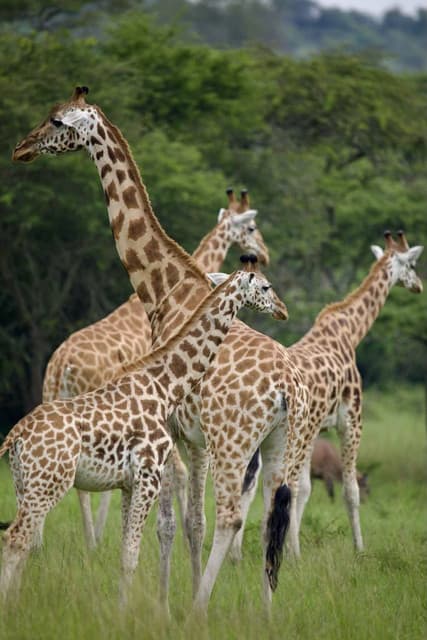
A giraffe cannot move quietly through a landscape. It is too tall, too visible, too impossible to ignore. And in Uganda, that visibility has become one of its most powerful conservation assets — not just for itself, but for every animal that shares its habitat. The story of how Uganda's giraffe went from the edge of local extinction to a population numbering in the hundreds is, at its core, a story about what happens when you build a serious conservation plan, ground it in science, and refuse to stop until it works.
But the wider significance of that plan is only now becoming apparent, at its midterm review. Uganda's National Giraffe Conservation Action Plan, launched in 2020, is not merely a species recovery document. It is emerging as a template, a practical demonstration of how structured conservation planning, backed by research and driven by community partnership, can protect wildlife across the board.
To understand what the giraffe conservation plan is teaching Uganda's wildlife sector, you have to understand the crisis it was designed to address. Through the 1970s and 1980s, giraffes vanished from park after park across Uganda, hunted out during a period of political instability that made enforcement impossible and law effectively meaningless. By the time security returned and conservation institutions began rebuilding, the giraffe was locally extinct across much of its former range. The lesson that the crisis taught was fundamental: wildlife cannot recover on goodwill and habitat alone. It needs structured intervention, coordinated reintroduction, systematic monitoring, community engagement, and a written strategy that holds everyone accountable.
"The habitat seems to be doing really well; it's still intact, the resources are there for the animals to survive," notes Arthur Muneza, GCF's East African Coordinator. "But security was a major concern. And that's what even drove the reintroduction of giraffes into these other areas where, before,e it would have been difficult, but now it's possible."
The action plan institutionalised that lesson. It turned what had been ad hoc conservation efforts into a coordinated national strategy with defined goals, measurable targets, and a review mechanism to keep it honest. That structure — arguably more than any single intervention — is what is producing the results now visible across Uganda's giraffe-range landscapes.
The research component of the giraffe action plan has produced findings that extend well beyond the species itself. Studies of snaring — conducted because giraffes were showing abnormal movement patterns and gait disturbances that alarmed field researchers — revealed the true scale of wire-trap proliferation across Uganda's parks. Snares set by poachers targeting small bushmeat animals were capturing giraffes, impeding their movement, and in some cases killing them when intervention was delayed.
That research triggered snare removal operations supported by GCF across multiple conservation areas — operations that benefit not just giraffes but every animal moving through those landscapes: lions, leopards, Uganda kob, buffalo, and dozens of other species that are equally vulnerable to indiscriminate trapping. The giraffe's visibility made the problem legible. The plan's research framework made it actionable. And the response protected wildlife far beyond the species that first raised the alarm.
Research into giraffe skin disease has similarly generated knowledge with broader veterinary value. Identifying the Staphanofilarial worm as the causative agent of lesions seen in Ugandan giraffes advances the understanding of wildlife parasitology across the region, providing a diagnostic baseline that other conservation programmes can use when similar conditions arise in different species.
The most enduring policy legacy of Uganda's giraffe conservation work may be the translocation and reintroduction framework it helped create. Dr. Gladys Kalema-Zikusoka, founder of Conservation Through Public Health and one of Uganda's most influential conservation scientists, was involved in some of the earliest giraffe translocations — including a dramatic operation that flew young giraffes from Kenya to Kidepo Valley in military aircraft because the roads were too dangerous to use.
"Everyone realised, actually, translocation is a good thing," Dr. Kalema-Zikusoka recalls. "And then I was asked to write a policy for translocation and reintroduction — and the giraffe was a very good case study." That policy now governs the movement of multiple species across Uganda, from elephants relocated out of conflict zones to antelopes reintroduced to restored habitats. The giraffe plan did not just recover a species; it produced the legal and operational framework that makes species recovery possible across Uganda's entire wildlife estate.
If there is one lesson from Uganda's giraffe conservation plan that the broader wildlife sector is absorbing most urgently, it is this: conservation succeeds or fails in communities, not in plans. The giraffe action plan has, from its inception, treated community engagement as a core pillar — not an afterthought — of its implementation strategy. Sensitisation work around Murchison Falls and Kidepo has focused on building a genuine understanding of why giraffes matter and what communities stand to gain from their protection. This mirrors the lesson Dr. Kalema-Zikusoka has spent her career demonstrating in gorilla and chimpanzee conservation: animals are safe when the people who live beside them want them to be safe. "Once animals are safe, their numbers will multiply," she says. "If they're not safe, they won't breed. So we have to make them safe, and they must feel protected."
Making wildlife safe in Uganda increasingly means making communities invested in that safety — through tourism revenue, through livelihoods support, through healthcare access, and through the kind of sustained engagement that the giraffe conservation plan has built into its architecture. That model, proven with the giraffe, is now being looked to as a template for protecting the full breadth of Uganda's extraordinary wildlife heritage.
In Uganda, the giraffe — tall enough to see over the acacia canopy, visible enough to be unmissable, charismatic enough to open conversations — has become more than a conservation success story. It has become a road map. And Uganda's wildlife sector is only beginning to follow where it leads.