World Bee Day: Celebrating Uganda’s young beekeepers who are protecting nature, pollinating food systems, and building livelihoods
In the hills of western Uganda, the sound of bees humming through coffee trees is becoming a sign of something bigger than honey production. It is a sign of livelihoods restored, ecosystems protected, and communities finding new ways to feed themselves while caring for nature.
For young beekeeper Rogers Ainembabazi from Ibanda District, bees first represented survival.
As the eldest child in a humble household, Rogers struggled to stay in school. He tried poultry farming to support his education and help his siblings, but the returns were too small, and the inputs were high. Beekeeping offered an alternative, one that required little land and little capital and relied largely on the natural environment.
His first harvest changed everything.
“I harvested a whole bucket of honey. I sold it and paid my school fees and my siblings’ fees,” he recalls.
Nearly two decades later, that single bucket of honey has grown into a thriving enterprise.
Rogers now manages more than 1,200 beehives, works with thousands of beekeepers in Uganda, and trains youth and women in modern beekeeping practices.
But for Rogers, beekeeping is not only about income. It is also about food systems and biodiversity.
“Bees are natural pollinators. They help in the pollination of our coffee and crops, increasing yields and improving food security,” he explains.
World over, bees play a vital role in sustaining agriculture by pollinating crops, fruits, and wild plants that communities depend on for food and nutrition.
Healthy pollinator populations contribute directly to resilient agri-food systems by increasing crop productivity, enhancing biodiversity, and supporting the ecosystems farmers rely on.
In Kasese District, near Queen Elizabeth National Park, another young beekeeper is seeing this connection firsthand.
Chris Kaseke, founder of Lake Gateway United Beekeepers Association, started beekeeping to address unemployment and reduce poaching in communities living near protected areas.
Today, beehives placed along the park buffer zones are helping transform former poachers into conservation champions.
“Beekeeping is a win-win project. Conservation wins and the community wins,” Kaseke says.
The project has also encouraged communities to restore vegetation and protect bee-friendly trees such as Calliandra, bottlebrush, and other flowering species that provide forage for bees.
“As a beekeeper, when there are no trees, then there is no production of honey. That is why beekeepers protect nature,” he says.
In Sheema District, teacher and farmer Eunice Ayebare began beekeeping after realizing that crop farming and teaching alone could not provide enough income for her family. Starting with six locally made hives in 2013, she gradually expanded her apiary after receiving training in modern beekeeping practices.
Today, her bees not only provide honey for home consumption and income but also improve crop yields in her community.
“There is a mango tree near the apiary that did not produce any fruit before. Now it produces many mangoes. Even the nearby coffee farmers are harvesting more,” she says.
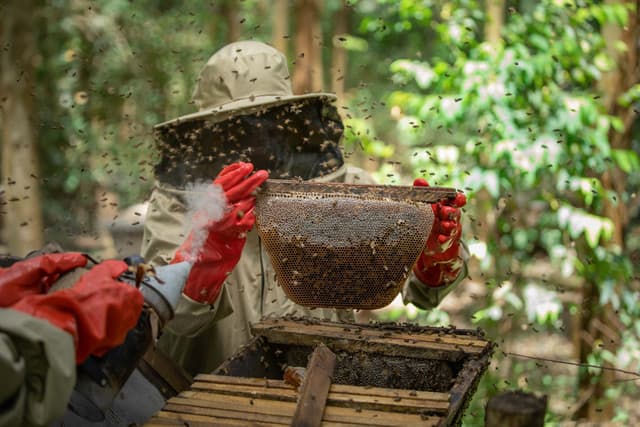
Under the project, “Mainstreaming Biodiversity across Agricultural Sectors to Implement the Kunming–Montreal Global Biodiversity Framework,” the Food and Agriculture Organization (FAO) is supporting honey producers in central and southwestern Uganda to improve honey quality and obtain Uganda National Bureau of Standards (UNBS) Q-Mark certification. Through training and technical support, the project is equipping youth beekeepers with skills in apiary management, modern honey production, processing, packaging, and marketing, while also supporting selected youth groups through the certification process to help them access better markets and improve livelihoods.
Laboratory testing and final certification processes are ongoing, with several promising youth-led enterprises already on track to acquire the Q-Mark certification.
Beyond honey, the impact extends to jobs, environmental conservation, and community resilience.
Rogers alone has trained over 5,000 young beekeepers and established honey collection centers across multiple districts.
As the world marks World Bee Day, their stories serve as reminders that protecting pollinators means safeguarding food systems, biodiversity, and livelihoods.
“Imagine a world without bees. There would be food scarcity because there would be nothing to pollinate many of the crops where we get our food,” Chris says.