GREEN EXCLUSIVES | EPISODE 2, PART I
Built for Resilience: Inside ECOTRUST's 27-Year Journey of Turning Nature into Opportunity
Very few organisations survive long enough to celebrate nearly three decades of consistent impact. Remaining relevant for 27 years in conservation—through changing governments, shifting donor priorities, evolving climate realities and growing community needs, requires more than resilience. It demands vision, innovation and an unwavering belief that people and nature can thrive together.
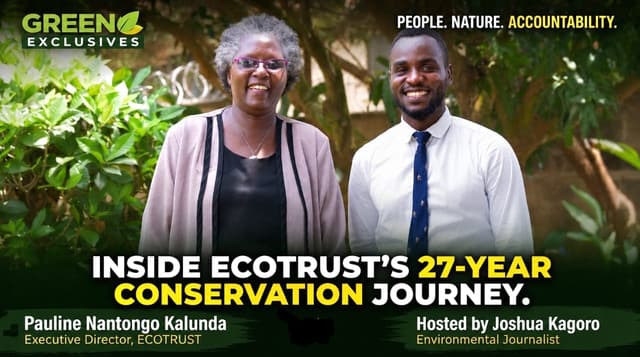
This year, the Environmental Conservation Trust of Uganda (ECOTRUST) marks 27 years of championing community-led conservation, landscape restoration and conservation finance. From humble beginnings as a USAID grants management unit to becoming one of Uganda's leading conservation organisations, ECOTRUST has helped reshape how communities value nature—not merely as something to protect, but as an asset capable of improving livelihoods.
Today, the organisation works with more than 54,000 smallholder households across five landscapes, supports restoration and improved management of over 70,000 hectares, has mobilised millions of dollars in conservation finance, pioneered biodiversity credits in Uganda and now aims to reach 16.5 million people while restoring another 60,000 hectares over the next five years.
For this edition of Green Exclusives, Environmental Journalist Joshua Kagoro sat down with ECOTRUST Executive Director Pauline Nantongo Kalunda to reflect on the organisation's remarkable journey, the lessons learned over nearly three decades and the future of conservation in Uganda.

Interface Opener
QN : Twenty-seven years is a remarkable milestone. When you look back to 1999, what story best captures ECOTRUST’s journey from where it started to where it stands today?
Pauline Nantongo Kalunda:
It’s been an exciting journey. By the time ECOTRUST started, I was just joining the work world. There were all these dreams.
ECOTRUST used to be a grants management unit of USAID. It was phasing out, but the stakeholders requested for it not to be phased out. Even the fact that stakeholders requested that this unit should continue showed that it was already appreciated as a very important unit.
But when it was converted into a Ugandan organization, then you are back into the dynamics that every Ugandan organization faces.
It was converted from a former grants management unit of USAID into a Ugandan organization, but with no money. So it had to go through the same things that all new organizations go through—coming up with innovative ways of mobilizing financing.
There were some good days because as soon as we started, USAID gave us five million US dollars to start with, but that was it. After four years, the real work started, so to speak.
But it has been an exciting journey because we have never been out of business. Even when the initial funding ended, the organization never went out of business.
It could have gone out of business, but it never did because it was already built for resilience.
The structures, the constitution and the charter of the organization already built it to be able to thrive through good and bad times.
Over the years, the organization has been able to come up with a resilient model. A model based on landscape restoration as a business.
It is a model that is not dependent on one source of funding. It is a model driven by the market.
ECOTRUST was one of the pioneer organizations that went into nature-based markets, supporting smallholder farmers to access the carbon market.
We have been participating in the carbon market for more than 25 years. The world has just woken up to carbon offsets and carbon markets as a major tool for climate mitigation, but we have been doing this for more than two decades.
It was built as an organization that is able to see opportunities—unique opportunities that make nature investable.
The farmers, the communities and partners that we work with, we work with them for a very long time, regardless of the normal structure of donor funding.
That journey has enabled us to craft a business model that can withstand shocks in the financial market, climate market, nature market, changes in institutions and changes in policies.
So it is a resilient organization.
QN : Looking back over nearly three decades, what are the three milestones that make you most proud, and why do they matter for Uganda’s environment and communities?
Pauline Nantongo Kalunda:
The three milestones come from innovation, impact and stewardship.
From innovation, it is being able to come up with a model that enables mobilization of financing from traditional and non-traditional sources.
We are able to access public and private philanthropy, but also generate our own income as an organization to the point that we have established an endowment fund.
From stewardship, every dollar that we mobilize from donors, we are able to mobilize at least six more dollars from the private sector. On top of that, we are also able to generate two more dollars from our internally generated revenue.
That model of stewardship is important.
If you remember the story in the Bible about those who were given talents—those who invested and multiplied what they were given received more. That story of stewardship speaks to what we do.
But also, the story of impact.
We operate in five landscapes. Every landscape that we enter into, we never leave.
For those 27 years, we have been able to work with about 54,000 households that we can track with GPS.
We can show you bare lands that have now turned into tropical high rain forests.
That is the story of restoration.
Within those years, we have achieved verifiable emission reductions, with millions of tons of carbon dioxide sequestered by forests planted over the years.
The communities we work with have more than 200 businesses.
Some are microfinance institutions, some produce and export honey, while others are involved in the management of what we call the shea parklands.
We are proud of our impact—the five landscapes, the carbon removed from the atmosphere as climate change mitigation, the households we work with and the community businesses we support.
QN: Conservation has changed significantly over the years. How has ECOTRUST evolved to respond to challenges such as climate change, biodiversity loss and increasing pressure on natural resources?
Pauline Nantongo Kalunda:
The way we locate our projects or programmes is to optimize on biodiversity conservation, climate change mitigation and livelihoods improvement.
Anywhere in Uganda where you operate, you should be able to generate climate benefits or livelihood benefits.
In order to make the three coincide, we locate our programmes in high biodiversity areas.
Our programmes are around Queen Elizabeth National Park, Rwenzori Mountains National Park, Murchison Falls National Park and all the forests around there, Mount Elgon and all the wetlands and forests around there, and recently Northern Uganda.
What we do is work with communities that we support to enter into co-management arrangements with those protected areas.
We would like the planting of trees on private land to also contribute to reducing pressure from a specific protected area.
So we come up with a vision with the community that clearly specifies what the impact to the protected area is going to be, but also what the contribution on private land is going to be.
Our model is based on the understanding that development does not have to be in competition with conservation.
What we do is make nature investable.
We come up with a business case for a smallholder farmer, for example, to find the presence of trees to be an economically viable land-use option that can compete with things like sugarcane growing.
That is the model we have developed.
We identify or create multiple opportunities for income generation.
Every farmer that we work with has a land-use plan, which also doubles as a business plan.
In that land-use plan, the farmer has a management objective for the trees.
They are not growing trees because they are saving the world. They are growing trees because they are producing, they are entering into a business of medicinal extracts, fruit production, fuel production, timber production or apiary.
That alone is economically viable.
But the major barrier is the investment horizon.
Whereas it takes you three months to grow beans and recover your money, it takes you 10 or 15 years to benefit from a tree.
What we do is help the farmer develop a model with multiple management objectives, where different incomes come in at different stages of the enterprise.
QN: ECOTRUST has become a pioneer in conservation finance and carbon programmes. How have these approaches transformed the lives of rural communities while protecting ecosystems?
Pauline Nantongo Kalunda:
One of the ways we do it is by commodifying the environmental services.
The same farmer who is growing a tree for production of avocados or mangoes, that same tree is also sucking up carbon dioxide.
That same tree is stabilizing soils and producing watershed services.
That tree is also inhabiting biodiversity and therefore producing biodiversity services.
One of the innovations we have is putting a monetary value to the service provided by the farmer.
We put a monetary value to climate regulation services through the carbon certification route.
We put a monetary value to conservation by creating what we call biodiversity credits.
We also put a monetary value to watershed services derived from the presence of trees on farms.
Those services are linked to companies, mostly in Europe and the United States, that have committed to having a zero net impact on the environment.
On an annual basis, those organizations conduct a footprint of their impact, invest in initiatives that reduce that impact, and whatever residual impact remains, they put a monetary value to it.
On this side, we have a database of farmers implementing different activities for their livelihood strategies.
We quantify the environmental services that come out of their work and link the farmers to the companies.
That is how we are able to create a connection between communities protecting nature and companies seeking to support environmental solutions.
Is it sustainable?
Extremely sustainable.
When a farmer is designing their own land-use plan, they are building resilience.
Trees are very useful in building resilience of productive systems.
Look at farms where trees exist. They are normally able to withstand droughts and excessive rains because soils are stabilized, runoff is reduced and moisture retention improves.
Some of these trees are nitrogen fixers, so farmers benefit from improved productivity of their land.
Remember, these trees are providing services for 25 years.
What other enterprise do we have where you invest once and productivity continues for at least 25 years?
So it is sustainable.
It builds the resilience of the farmer, but as the farmer builds their own resilience, they are also offering a service to the rest of the world.
We are simply enabling the farmer to monetize that extra service.
QN : Communities are often described as the first line of defence for nature. From your experience, what have local people taught ECOTRUST about conservation that textbooks never could?
Pauline Nantongo Kalunda:
The stories of farmers that work with us are not different from what I am saying.
You should go and visit them.
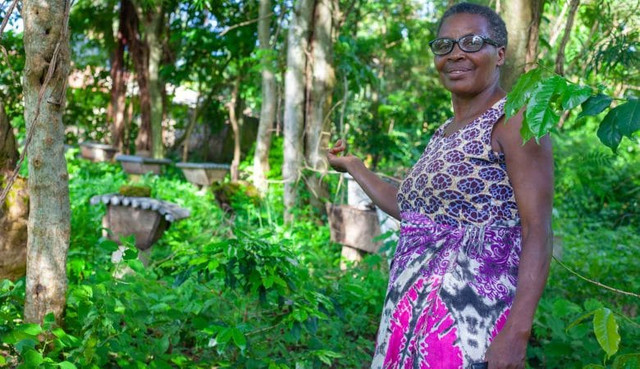
These are farmers who have completely changed their investment horizons.
They are no longer thinking in terms of short-term gains. They are thinking in terms of return on investment.
Most smallholder farmers have an investment horizon of three months.
You plant, you harvest, you sell and prepare for the next season.
It normally does not go beyond that.
But for a farmer to sit down and say, "This is the land use I am going to have for the next 25 or 35 years," that is not simple.
Changing your planning horizon from three months to 35 years is a major transformation.
Farmers have built schools.
Farmers have moved from never saving to creating circles where they own and manage their own financial systems.
Some circles use carbon payments as collateral for loan financing.
Some have bought land and constructed clinics where members have access to healthcare.
Even the government is trying to develop insurance products for everyone, but here we have farmers who have created their own systems.
It is a transformational programme.
When we started our tree planting programme, it was mainly focused on native trees—Musizi, Musambya, Mvule and other Ugandan species.
At that time, there was very little literature in Uganda on how to grow these trees because they were mainly found naturally in forests.
The literature existed on managing forests, not growing these trees.
Farmers helped generate knowledge on how these species are raised.
By the time we were five years into the programme, farmers had developed systems experimenting with more than 20 different Ugandan tree species.
They taught us how to raise those trees.
There are also indigenous knowledge systems.
Farmers have ecological indicators.
They know when certain ants appear, it means rain is coming.
They understand signs about the health of habitats that are not necessarily written in books.
There is so much farmers have taught us.
QN: Uganda continues to face deforestation, wetland degradation, pollution and climate-related disasters. From your perspective, what is the current state of our environment, and what concerns you the most?
Pauline Nantongo Kalunda:
What concerns me the most is that while the people who are at the frontline of environmental disasters and suffering are investing so much in trying to protect nature, the rest of us are often the ones causing the problem.
Those of us in Kampala use polythene bags, clog waterways, drive cars, run industries, grab land, convert forests into sugarcane plantations and build in wetlands.
Yet we continue thinking that local communities need mindset change.
We waste a lot of resources.
Uganda's National Development Plans clearly show that we are a nature-dependent economy.
But our approach is not to manage nature as an asset. We manage it as a source of raw materials.
That lack of realization that these resources are not infinite—that we need to handle them as assets that we invest in—is what concerns me.
When you have a house that gives you rental income, you repair it, maintain it and make it attractive for the next tenant.
But the way we deal with nature is different.
We extract, destroy and move on to the next resource.
We need to start treating nature like the asset it is.
QN : Despite the challenges, where do you see hope? Are there encouraging trends or success stories that convince you Uganda can still reverse environmental degradation?
Pauline Nantongo Kalunda:
Yes, we can reverse environmental degradation.
We are not in the worst position.
We have a very good location.
We are located around the equator and we do not need too much to grow things back.
Many wetlands do not even need active restoration. If you remove the barriers and challenges, they can recover.
It is not just a slogan that Uganda is gifted by nature. We are actually gifted by nature.
We are located in the centre of Africa.
We have biomes characteristic of Sudan and Guinea.
We have habitats characteristic of West Africa, East Africa and Southern Africa.
There are species whose southernmost or northernmost ranges reach Uganda.
Our soils and ecosystems have enormous potential.
We bought a piece of land in the Rwenzori Mountains in 2001. It was a cattle farm.
We developed a management plan and fundraising strategy.
When we returned in 2006, the fundraising strategy was almost unnecessary because the land had already converted itself back into a forest without major investment.
We only removed exotic trees planted when it was a cattle farm, and the area recovered naturally.
So there is hope.
If we have commitment and proper planning, recovery is possible.
How Conservation Finance is Turning Communities into Custodians of Nature
After 27 years of community-led conservation, ECOTRUST’s journey has been shaped by innovation, partnerships and a belief that nature must be treated as an asset worth investing in. From linking smallholder farmers to global carbon markets to developing new approaches in biodiversity conservation, the organization continues to explore how conservation can deliver both environmental and economic benefits.
In this second part of Green Exclusives, Executive Director Pauline Nantongo Kalunda reflects on the power of partnerships, the impact of ECOTRUST’s flagship Trees for Global Benefit programme, the future of carbon markets, the role of smallholder farmers and young people in climate action, and the legacy she hopes ECOTRUST will leave for Uganda’s conservation future.
PART II
QN: ECOTRUST works closely with government, development partners, the private sector and local communities. What has made these partnerships successful, and where do you think collaboration still needs to improve?
Pauline Nantongo Kalunda:
The partnership has been successful because of the multi-sectoral approach.
For you to be able to pull off such an innovation, you need to combine science with finance, with stewardship, with innovation and so many other things.
There is no single sector that is complete in all those areas.
We have to work with the finance sector, for example banks, microfinance institutions and others.
We have to work with technology because the digital technology revolution has really given us opportunities to remove quite a bit of the challenges and the manual work that has existed in conservation and working with smallholder farmers.
Technology has also created opportunities for young people to participate.
For example, monitoring platforms are manned by the youth, especially teenagers and those below 25 years.
We have to work with that category.
Government also provides the enabling environment, and we have been offering ourselves to pilot many of the policies that government comes up with.
For this particular industry, the enabling environment is very diverse, especially issues that create inclusivity.
When you are going into climate regulation, climate mitigation and building resilience, some people do not understand that the financial sector is important.
For example, agricultural products are some of the most expensive because of climate risk.
That is already an enabling environment—or sometimes a disabling environment.
It becomes difficult for farmers to buy a tractor or equipment that would help them build resilience because interest rates are high.
The risk is looked at from the perspective of exposure to climate challenges, instead of looking at the investment being made to reduce that risk.
That is why we engage sectors like finance to create an environment where investments can happen.
For example, through innovations where smallholder farmers have collateralized carbon credits, they are able to access cheaper financing and they do not have to stake their land titles, which many of them do not have.
Most smallholder farmers own land but do not have documentation proving ownership.
So they have nothing to take to the bank.
You and I may have a land title that can help us access financing, but they do not.
That is why these partnerships are important.
QN: Looking at some of ECOTRUST’s flagship projects across landscapes such as Queen Elizabeth, Murchison-Semuliki and Mount Elgon, which initiatives have had the greatest impact, and what lessons can others learn from them?
Pauline Nantongo Kalunda:
Trees for Global Benefit has had the greatest impact.
Trees for Global Benefit is a cooperative carbon offsetting scheme that links smallholder farmers to the global voluntary carbon market.
It has had the greatest impact and provided lessons for almost everything we do today.
It operates in all the five landscapes where we work.
We also have a land trust programme.
In that programme, we either own land or support communities to establish communal associations where they create community reserves.
For example, if Trees for Global Benefit has enabled restoration of about 40,000 hectares, those hectares are not private land only.
In addition, those farmers participate in co-management arrangements for other conservation areas.
Trees for Global Benefit builds social capital.
Farmers are not only focusing on their own land but also on the conservation of protected areas.
It has been phenomenal in its impact.
QN: Carbon markets continue to generate global debate. What opportunities do you see for Uganda, and what safeguards are necessary to ensure communities receive fair and lasting benefits?
Pauline Nantongo Kalunda:
The opportunity is that Uganda has enormous potential because we have communities that are already managing landscapes.
The question is how we create systems that recognize and reward the services they provide.
Carbon markets should not only be about selling credits.
They should be about ensuring that communities are at the centre.
The farmer must benefit.
The community must benefit.
The environmental integrity must be maintained.
That is why we have spent years building systems where communities understand what they are participating in, where they have ownership, and where the benefits are clearly structured.
The future is not just carbon.
It is about biodiversity credits, watershed services and other environmental services.
Nature provides many services, and we need to create mechanisms where those services are valued.
QN: As Executive Director, what has been your most difficult moment in leading ECOTRUST, and what has kept you motivated through those challenges?
Pauline Nantongo Kalunda:
One of the most difficult moments was when I had just joined ECOTRUST.
ECOTRUST was a big organization. It had many cars and offices in Kololo, so I thought it was a rich organization.
Then after I signed the contract, the board explained to me that actually USAID funding had come to an end.
They were trying to decide whether to close down the organization or find somebody who could continue making it a growing concern.
I was the only staff member left because all the other staff had left with the closure of the projects.
Coming from a place where I had a salary and security, I had joined an organization I thought was successful, only to realize it was almost collapsing.
The thought that it could die on me was quite challenging.
But it is also good to be young.
When you are young, you do not perceive risks the same way.
I do not think I would have taken up that organization today with all the grey hair I have now.
At that time, I had applied for several jobs.
When they explained the situation at ECOTRUST, some of the other places where I had applied gave me offers.
But I did not quit.
I used to play basketball and rugby.
When you are a sports person, you are not a quitter.
You know there are good times and bad times.
You learn how to lose and how to win.
So I took it on like a game.
I looked at it like a club facing relegation, and I had a responsibility to bring it back on course.
That was the attitude I had.
You could throw anything at me, and I would try to find the good things in it.
And things worked out.
QN: If you had the opportunity to influence one major environmental policy or national investment today, what would it be and why?
Pauline Nantongo Kalunda:
I would influence the positioning of the local community and the smallholder farmer in all these policies.
Smallholder farmers and local communities should not be looked at as vulnerable people who need to be safeguarded.
They should be looked at as the game changers.
They are the people who can actually transform the situation.
Agriculture is one of the leading causes of deforestation in Uganda, and about 80 percent of land under agriculture is in the hands of smallholder farmers.
Even commercial agriculture, like sugarcane production, depends on outgrowers.
So the power to change is in the hands of smallholder farmers.
I would recommend policies that look at the smallholder farmer for who they are and what they bring to the table, and create space for their innovation to be harnessed.
QN: Young people are increasingly passionate about climate action. What role do you see youth playing in shaping Uganda’s environmental future, and what advice would you give to the next generation of conservation leaders?
Pauline Nantongo Kalunda:
Youth come with different assets and skill sets.
For example, young people are technology savvy.
There is a lot we can harness from technology—in information dissemination, marketing products, mobilization and monitoring.
There is a need to harness their power instead of demanding that they behave like old, experienced people.
We should not demand the same contribution from young people as those who were born before computers.
Young people have different strengths.
We need to recognize those strengths and create space for them.
QN: As ECOTRUST celebrates 27 years, what legacy do you hope the organization will leave for Uganda over the next 27 years?
Pauline Nantongo Kalunda:
I hope that we will reverse degradation and deforestation.
Instead of being in the negative, we should move to zero and then have positive gains.
I hope we will see Uganda's natural resources recovering and communities benefiting from conservation.
QN: Finally, when people hear the name ECOTRUST decades from now, what do you hope they will remember it for?
Pauline Nantongo Kalunda:
ECOTRUST will be remembered as one of the very innovative organizations that was able to combine science and finance to harness the stewardship, innovation and trust of local communities and use it to protect Uganda's natural resources.
We do get donor money to deliver it to communities, but we are here to get all sorts of financing from wherever it exists and channel it to where it matters most.