Five years after Dr Barirega Akankwasah took charge of the National Environment Management Authority (NEMA), the authority is positioning itself at the centre of Uganda's fight against environmental degradation, backed by stronger enforcement, digital systems, increased staffing, and a growing case for the government to treat the environment as critical national infrastructure.
Dr Barirega has just marked five years in office, a period that has seen NEMA undergo significant institutional changes while confronting some of Uganda's biggest environmental challenges. His five-year milestone comes at a time when the country is grappling with wetland encroachment, forest loss, pollution, poor waste management and the growing effects of climate change. The NEMA Executive Director spoke about his five years in office, the authority's achievements, challenges and plans in the third episode of Green Exclusives, an environmental programme hosted by environmental journalist Joshua Kagoro.
For Dr Barirega, the numbers tell a story of an institution that has undergone significant change but also one confronting an environmental crisis that demands far greater investment and political commitment. Uganda's forest cover, which had dropped to about nine percent of the country's land surface, has now recovered to about 13 percent, while wetland coverage has increased from 8.9 percent to 13.9 percent, according to figures cited by the NEMA boss. The authority has also recorded improvements in air quality monitoring, while a major digital transformation has dramatically changed how investors and developers access environmental services.
"We've achieved quite a lot, but a lot remains to be achieved," Dr Barirega said during the interview.
He said NEMA's transformation has been visible across almost every major area of environmental management, from ecosystem restoration and pollution monitoring to licensing, compliance and enforcement. But the progress also raises a bigger question: how does Uganda sustain these gains and protect its environment as the country continues to pursue economic growth and infrastructure development? For Dr Barirega, part of the answer lies in what can be described as a big green shift: a change in how Uganda views, plans for,r and invests in the environment.
Digital NEMA: Cutting Red Tape, Protecting the Environment
Perhaps one of NEMA's most consequential reforms has been the automation of its business processes, a move the authority says is helping to strike a delicate balance between environmental protection and economic development. Environmental and Social Impact Assessment certificates can now be processed online, allowing applicants to submit documents, make payments and receive certificates without physically visiting NEMA offices.
The impact has been immediate.
Applications for Environmental and Social Impact Assessments have risen from about 1,600 annually in 2021 to around 6,000, while annual environmental audit submissions and processing have increased from just over 500 to nearly 7,000. For a regulator often accused of slowing investment, the digital transformation is being framed as a strategic shift, making environmental compliance easier while reducing the temptation for developers to bypass regulation.
"If an investor is going to be frustrated in getting the license, they will take a shortcut and not come for regulation," Dr Barirega warned, arguing that efficient regulation is itself an important tool for environmental protection. The reforms point to a broader vision of NEMA not simply as an enforcement agency, but as an institution facilitating sustainable development.
NEMA's institutional growth has also been dramatic.
In 2021, the authority had about 130 staff. Today, its approved establishment stands at 500 positions, with more than 300 already filled. The government has also sanctioned the establishment of an Environment Protection Force, which NEMA sees as a major missing piece in Uganda's environmental governance architecture. The first cohort of personnel has already undergone training as the country moves towards building a dedicated force to strengthen environmental enforcement. For years, environmental laws have existed on paper, but enforcement has often been criticised as weak, inconsistent or overwhelmed by the scale of degradation.NEMA now believes stronger boots on the ground could change that. But Dr Barirega insists the goal is not to create an institution that Ugandans fear.
"A regulator must be respected, not feared," he said, arguing that citizens should be more concerned about the consequences of environmental destruction,n including floods, droughts, pollution and diseases,se than the authority responsible for enforcing environmental laws. NEMA, he said, wants to be understood as a pro-people institution whose enforcement actions are ultimately intended to protect livelihoods and public welfare.
Forest Recovery Offers Hope, But Pressure Remains
Uganda's recovering forest cover is among the strongest indicators of progress cited by NEMA. After falling from approximately 45 percent of the country's land surface in the early 1900s to just nine percent in 2015, forest cover has now climbed to nearly 13 percent. The country is targeting 15 percent forest cover by 20 40. Dr Barirega believes the target is achievable, crediting public mobilisation and tree-planting initiatives for helping reverse decades of forest loss.
But the recovery story comes with a warning.
Illegal logging, charcoal burning and encroachment continue to threaten natural and central forest reserves across the country. The challenge, according to the NEMA boss, is not simply the absence of laws. It is also the absence of adequate investment in institutions responsible for managing ecosystems on the ground. He argues that Uganda needs properly demarcated forest boundaries, more forest guards, rangers and permanent management structures rather than relying only on periodic operations involving regulators, police or the military.
"We need boots on the ground on a day-to-day basis," he said.
The argument is likely to resonate with policymakers as government weighs competing national priorities and increasingly confronts the financial consequences of climate change and environmental degradation.
Environment Must Be Seen as Infrastructure
Perhaps the most important policy message from the interview is Dr Barirega's call for Uganda to fundamentally change how it finances and values the environment.
"Environment must be seen as an infrastructure," he said.
His argument is simple: the cost of protecting wetlands, forests, rivers and ecosystems is far lower than the cost of repairing infrastructure destroyed by environmental degradation. A bridge washed away by floods, a road destroyed by extreme weather, or communities displaced by flooding all come with enormous financial consequences. For NEMA, environmental conservation should therefore no longer be treated as an afterthought in national planning.
"It must be our deliberate decision to invest and prioritize the environment," he said. The authority is calling for increased investment not only from government, but also greater participation from citizens, arguing that environmental protection cannot be delivered by the state alone.
“Government can build roads and hospitals, but it cannot manufacture clean air, clean water and healthy soils for citizens,” Dr. Barirega noted. Those depend on collective responsibility. The policy challenge, therefore, is how Uganda integrates environmental protection into infrastructure planning, public investment and everyday development decisions.
NEMA's Budget Triples, But the Gap Remains
There has been progress in government funding. NEMA's annual budget has increased from approximately Shs13 billion in 2021 to about Shs40 billion. For an institution mandated to oversee environmental management across an entire country, the increase represents a significant shift in government prioritisation. But Dr Barirega says the funding remains insufficient compared to the scale of Uganda's environmental challenges.
"It is still a drop in the ocean," he said.
The funding debate is particularly critical as Uganda faces growing pressure on forests, wetlands and water bodies, while pollution, rapid urbanisation and waste management continue to create new environmental risks. For policymakers, the message from NEMA is increasingly difficult to ignore: environmental degradation is expensive, and failing to invest in prevention may ultimately cost the country far more.
From Landfills to a Circular Economy
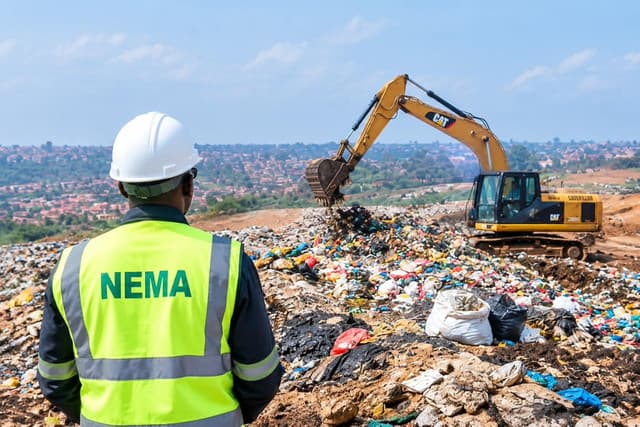
NEMA is also pushing for a major rethink of Uganda's waste management system. The crisis at the Kiteezi landfill, Dr Barirega said, should serve as a national wake-up call.
The future, he argues, should not be centred on simply finding more places to dump waste. Instead, Uganda must move towards waste sorting at source, recycling, composting and other forms of value addition. Organic waste can be turned into compost, fertiliser, biogas and briquettes, while plastics, metals, paper, wood and textiles can increasingly enter recycling value chains.
"Landfills are a thing of the past," he argued, calling for a transition from a linear economy to a circular economy where waste is treated as a resource. But technology alone will not solve the problem. NEMA believes Uganda's biggest challenge is behavioural.
Households must begin separating waste at source, while government and the private sector build stronger markets and value chains for recycled materials. The vision is simple but ambitious: minimal waste reaching sanitary landfills and maximum value extracted before disposal becomes necessary.
The Next Battle: Pollution
Beyond forests and wetlands, Dr Barirega identifies pollution of air, water and soil as one of Uganda's most serious emerging environmental threats. Unlike a destroyed forest or encroached wetland, pollution is often less visible. But its consequences can be far-reaching, affecting the air people breathe, the water they drink and the soil used to produce food. This is where NEMA's future will increasingly be tested. The authority has already expanded air quality monitoring, recording significant improvements from levels previously above 40 micrograms per cubic metre for particulate matter to a national average of around 20, while Kampala remains higher.
But the growing challenge of urbanisation, industrialisation, transport and waste means pollution will require stronger regulation, better data and greater public awareness. A Defining Moment for Uganda's Environmental Future: NEMA's transformation over the past five years reflects a larger shift in Uganda's environmental conversation. The institution is bigger. Its budget is larger. Its services are increasingly digital. Its enforcement capacity is expanding. And some of the country's key environmental indicators, particularly forest and wetland recovery, are showing progress.
Yet the bigger story is not just about what NEMA has achieved. It is about what Uganda chooses to do next. The authority is now making a clear case to government, Parliament, investors and citizens: environmental protection is not an obstacle to development; it is the foundation of sustainable development. For policymakers making decisions on infrastructure, urban development, agriculture, energy and public spending, that may be the most important message coming from NEMA's transformation. Dr Barirega argues, cannot afford to wait until floods destroy roads, pollution damages public health or ecosystems collapse before investing in protection.
The environment, he says, must be planned for, financed and protected with the same seriousness given to the country's physical infrastructure. And as NEMA looks towards the future, its success may ultimately be measured not by how many offenders it evicts or arrests, but by whether Uganda builds a development model in which enforcement becomes the exception and environmental responsibility becomes the culture. The five-year milestone therefore comes with both a record of progress and a challenge for the years ahead.
Uganda's big green shift will ultimately require more than a stronger regulator. It will require the environment to be built into the country's development decisions,s from roads and cities to agriculture, energy, waste management and public investment. For Dr Barirega, that shift is no longer optional.
The environment must be treated as infrastructure.