CABI Turns Agricultural Show into Practical Classroom for Safe Farming and Biological Pest Control
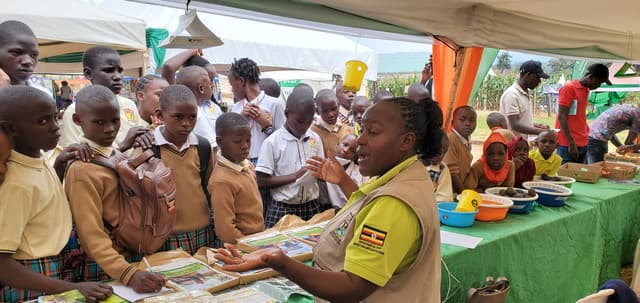
JINJA – Beyond exhibiting technologies, the Centre for Agriculture and Biosciences International (CABI) transformed its space at the 32nd National Agricultural Show into a practical learning centre where farmers, students and extension workers received hands-on guidance on safer crop production, biological pest control and responsible pesticide use.
Working alongside Uganda's Ministry of Agriculture, Animal Industry and Fisheries (MAAIF), CABI used the show to demonstrate how farmers can protect both their crops and their health by adopting Integrated Pest Management (IPM) practices instead of relying solely on pesticides.
Visitors received information on the safe use of pesticides, including correct application, proper handling, use of protective gear and responsible disposal practices aimed at reducing health risks to farmers while protecting soils, water sources and beneficial organisms.
Officials explained that safe pesticide use not only safeguards human health and the environment but also helps produce food that meets domestic and international sanitary standards.
A major attraction at the exhibition was CABI's continued public education on biological control of invasive pests affecting Uganda's horticultural crops.
Together with the National Agricultural Research Organisation (NARO), CABI demonstrated how tiny beneficial parasitoids are being used to naturally suppress papaya mealybug populations that have affected papaya production in districts such as Kayunga and Luwero. The parasitoids are reared at the National Agricultural Research Laboratories in Kawanda before being released to control the pest naturally.
"The biological control agent has helped farmers produce cleaner fruit and increase yields. The approach is being expanded to more districts under the EU SPS project," said Dr Caroline Nankinga, the EU Sanitary and Phytosanitary (SPS) Project Manager.

The parasitoids attack the pest at different stages of its life cycle without harming people, livestock or beneficial insects, providing farmers with a sustainable alternative to repeated chemical spraying.
Emmanuel John Namasa, Agriculture Inspector in MAAIF's Department of Inspection and Certification, said biological control is already producing visible results.
"The biological control that the ministry deployed has helped to reduce this pest, so farmers are now able to produce. The yields are increasing, the fruits are cleaner and safer for consumption," Namasa said.
CABI also introduced visitors to its Plantwise programme, where trained Plant Doctors diagnosed crop problems and advised farmers on affordable and appropriate management options. Young people visiting the exhibition were introduced to CABI's pest information resources and trained on pest identification, responsible pesticide use and accessing digital advisory platforms.
Digital information tools demonstrated at the exhibition allow farmers to receive real-time advice on pests, diseases, weather conditions and safe pesticide use through their mobile phones.
As climate change, invasive pests and stricter food safety requirements continue to challenge agriculture, extension services and farmer education are becoming just as important as new technologies. CABI's approach places knowledge directly into the hands of farmers, enabling them to make better production decisions while protecting both public health and the environment.
The activities formed part of the European Union-funded SPS Uganda Project, which seeks to strengthen Uganda's capacity to produce safer, healthier and export-ready horticultural products.