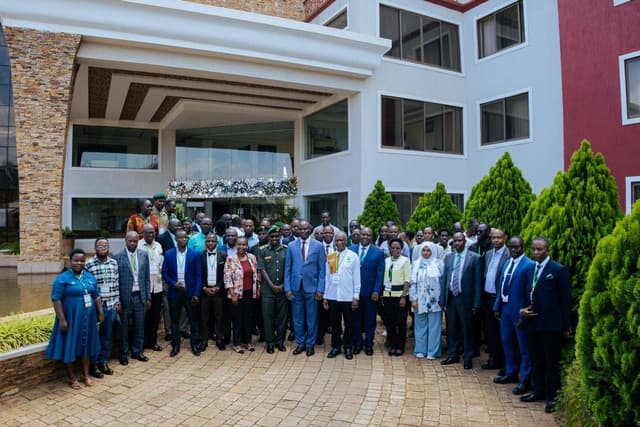
For years, the scientists studying Uganda's dwindling wildlife and the policymakers tasked with protecting it have operated in separate worlds, publishing in different journals, meeting in different rooms, drawing on different datasets. This week, for the first time in Uganda's conservation history, those worlds collided. The inaugural National Biodiversity Research Symposium, jointly convened by the Uganda Wildlife Authority (UWA) and the Uganda Wildlife Research and Training College (UWRTC), brought together an unprecedented assembly of field researchers, conservation biologists, ecologists, and government officials to confront a mounting biodiversity emergency with a single weapon: empirical evidence.
"There are many threats afflicting our biodiversity and our wildlife," said Dr. James Musinguzi, Executive Director of UWA, addressing delegates at the opening of the symposium. "These threats and gaps must be closed by using empirical data and evidence picked from research,h not assumptions, not politics. Science."
The symposium arrives at a moment of acute urgency. Across Uganda's protected areas, ecosystems that took millennia to evolve are being dismantled by a convergence of forces: climate-driven habitat shifts, invasive species colonising national parks, accelerating human encroachment, and a poaching trade that has shown no signs of abating. What has been missing, officials acknowledge, is a coherent, data-led national response.
Dr. Musinguzi was blunt about one of the structural failures compounding the crisis: institutional silos. Government bodies responsible for conservation, research, training, and tourism policy have too often worked in isolation, duplicating efforts and wasting scarce resources. The partnership between UWA and UWRTC, both under the Ministry of Tourism, Wildlife, and Antiquities, is a deliberate corrective.
"We need to work in a coordinated manner as government institutions so that we can use little resources to produce a huge impact," he said. "This symposium is proof that collaboration and partnership can yield much greater results."
The research presented at the symposium will not disappear into filing cabinets. UWA has announced the launch of a peer-reviewed research journal to disseminate findings globally, alongside a digital biodiversity data repository, a national knowledge bank that officials say will serve as Uganda's scientific contribution to the worldwide effort to understand and reverse biodiversity loss.
Crucially, the initiative carries a revenue dimension. By opening Uganda's extraordinary biodiversity to structured international research partnerships, UWA aims to attract foreign universities and institutions whose students and scientists pay for research permits and field access. Conservation, in this model, pays for itself.
"We are going to generate funds from research," Dr. Musinguzi confirmed. "We are setting up a depository of knowledge, and that knowledge has value."
The symposium is planned as an annual event, establishing a permanent rhythm of scientific review and adaptive management. For a country that hosts 50% of the world's mountain gorilla population and extraordinary concentrations of Albertine Rift endemics, the stakes of getting conservation policy right have never been higher.